
Competing pressures at work can erode staff capacity to recover quickly from crises, problems or disruption. Former GP practice manager Luan Stewart shares tips on how to strengthen resilience.
Many practice managers are feeling overwhelmed as a result of constantly having to juggle a heavy workload and balance tight finances. They also shoulder the additional responsibility of managing teams facing similar pressures and stresses.
Increasingly, it’s affecting resilience both at individual and team level, and compromising the ability to handle workplace problems and challenges.
Ultimately, this can harm a practice’s performance. People and teams that aren’t resilient can lack self-awareness, confidence in their abilities, or the strength to adapt or cope with problems that arise. They can also have a more negative outlook, making dealing with change more difficult and slowing down processes.
By contrast, in the face of an issue or problem, a resilient person is able to:
- Stay calm
- Step away and give themselves thinking time before responding or taking action (preventing making a situation worse, such as sending an angry email)
- Communicate effectively
Ensuring that you and your team can stay resilient is therefore paramount.
Reassuringly, there are some fairly straightforward steps you can follow as well as changes you can implement – some health-based, others connected with our work routines - to combat some of the strain and improve personal and team resilience.
Work habits
Clear the clutter and chaos
It’s true that a tidy desk can help you have a clearer mind. It can feel stressful working at a desk with piles of paper falling everywhere or one that has rubbish left all over it. It also wastes time since nothing can be found easily.
So make sure you clear the clutter that has built up in your workspace. And to keep it that way, take a few minutes every day before you start work (or when you finish work) to organise, clean and tidy it
Where you have hot desking in place, it’s important to remind team members that desks should be left clear and clean too. Having to ‘hot-desk ‘ with a messy desk can create a bad start to the day.
Making the work environment more attractive and pleasant can help you feel calmer. Create space in your office/ work area by looking to see how many paper-based documents can be digitalised. You might then be able to get rid of old filing cabinets etc, further decluttering the room or area. Do refer to NHS England’s Records Retention and Disposal Schedule if unsure about what needs to be retained and for how long.
Having plants in your work area can help relieve stress and improve air quality, as well as look pretty. Using diffusers can also help your workspace smell fresh.
Be email savvy
The huge number of emails landing into our inboxes every week is daunting. While we try our best to keep on top of all the new information being sent to us, there’s always a nagging fear we will miss something important.
Here are a couple of tips to managing your inbox. Start regularly ‘junking’ emails from senders/providers that you do not need to hear from. Just left click on the email and add to junk - this will immediately reduce the number of emails coming in, making it easier to sort through the ones you do need to read.
Also, if you use an app version of outlook, you can categorise the emails you see by ‘focussed’ and ‘other’. Often, the majority of the emails classed as ‘other’ can be simply deleted, again leaving your inbox in a more manageable state. This will give you some headspace to work through the 'focussed' emails.
Take your breaks
Rest is vital; it helps you cope with the strain and stresses of work. Take all of the annual leave you are entitled to since it helps with wellbeing and maintaining a healthy worklife balance.
And day-to-day, it’s just as important to protect your lunch break as much as possible.
Avoid swapping your work screen for your phone; instead, take some time away from electronics. Take a walk if you can and boost your health with some fresh air to clear the thoughts of work. You will find you will achieve more by taking a break than working through lunch, as clearing the mind makes us more efficient.
Avoid productive procrastination
Are you guilty of doing ‘busy work’ to avoid the tasks, projects or areas that most require your attention? Adjust your mindset and start sorting your workload into manageable tasks in order of importance – it will boost efficiency. By prioritising workload and tackling the urgent work first you will stay ahead, making it easier to manage other tasks. It also helps you feel a sense of achievement.
Keep your emotions in check
When working in a leadership role, it’s important to put in place 'emotion management'. It will help you deal with some of the trickier parts of the job. For example, if you try to be friends with everyone, it can make it hard to set new rules or procedures or address staff performance.
Don’t take it to heart that you aren’t invited to everything staff are doing - it may be because your team see you as the boss.
Take advice from co-founder of Apple, Steve Jobs, who said: ‘If you want to make everyone happy, don’t be a leader, sell ice cream.’ Management isn’t for everyone.
Make use of tools that can aid focus
If there are several work areas that you want to see improvements in or make positive changes to, such as worklife balance, time management or working relationships, it can be hard to decide where best to make a start.
The wheel of work is a self-assessment tool that can help you prioritise the issues to focus on, which can, in turn, aid resilience. Read more about it here. See also the box below for more details on how to use the wheel of work.
Once you have identified the areas or categories you wish to spend more time reviewing and improving, draw up some goals. However, only focus on one area at a time – it would defeat the purpose of this exercise, if it ended up becoming overwhelming as well!
Signpost to resources and seek out training support
Create a ‘help list’ for your teams, setting out health and wellbeing apps and NHS staff groups that they can access if they need help with both work and personal issues. This will support team resilience, which will benefit you too and make your job feel easier.
Many resources and apps are listed by NHS England here. There are also details of resources for NHS staff, including a free telephone helpline, to help with their financial wellbeing here.
For people who need someone to talk to, NHS England has introduced a confidential 24/7 text support service. The service can be accessed by texting SHOUT to 85258 and is available to all NHS colleagues who may have had a tough day, are feeling worried or overwhelmed, or have a lot on their mind and need to work through it.
Lastly, it may also be worth finding out if there is any resilience training available for your team, perhaps from the LMC or local training hub.
Health habits
Watch your caffeine intake
Drink water! It seems obvious to say, but this advice is often ignored. Keeping yourself hydrated will support brain function and help you work better.
Have you noticed that your team members often get irritable in the afternoons? This can be a result of caffeine overload.
To support team members’ resilience, try to have decaffeinated options of hot drinks available, such as decaf tea and coffee. Instant hot chocolate is cheaper than coffee and offering a warming drink in the afternoon can be a great way of making your team members feel looked after. It will give them a mood boost without the harmful effects of excess caffeine, which can increase anxiety and irritability.
Form good sleep patterns
Try not to take work home with you, although of course it’s easier said than done! If you do find your mind wandering to work in the night, there are coping strategies you can adopt. Place a pen and paper by your bed, so you can write your ideas/thoughts down to get them out of your head, leaving you to relax.
Or you can email yourself the tasks you suddenly remember you must deal with as soon as you get to work, so they don’t play on your mind.
Lavender pillow spray can help promote a good night’s sleep as well!
Let go of all the worrying!
As managers, we often find ourselves worrying about areas that are completely out of our control, like what date will we be told flu vaccines can start being given or what areas of work will we be given in new contracts, and so forth.
These worries can take over, with the result that we spend too much time stressing about issues we can do nothing to change, reducing the reserves of resilience we have to cope with issues we can control.
Try to worry only about the things you can control or influence, not the stuff you can’t! One example that works for me is when I’m given a task that I know is simply a tick-box exercise, I just get it done and don’t spend valuable time mulling over it, no matter how irritating it is.
When it comes to a task that involves the team that they think is a waste of time or won’t work, my approach is to explain what we have to do and why (i.e. we won’t get any income if we don’t follow the processes so they understand the rules are not mine), encourage them not to worry about it because they can’t change it, and then find practical solutions.
When we were told we had to use care navigation templates, I tried to minimise the time the team spent being stressed by it and explained that we just had to find a way to make it work. We did – we changed the clinical system so the templates popped up on the computer screen as soon as someone answered the telephone.
To conclude, there may be some tips and advice you feel sceptical about or don’t believe can really help. I would say try them out anyway, what have you got to lose?
How to use the wheel of work
This tool is a simple means of identifying areas that may benefit from development in your working life.
By using it, it can encourage you to:
- Reflect on different areas of your working life
- Identify the areas of your work life that need attention
- Create forward momentum and help you develop your action plan for success.
Follow these three steps.
1. Draw your wheel
Make sure you’re happy with the categories on the wheel. The template below gives some examples of categories but can be amended so it's most relevant to you.
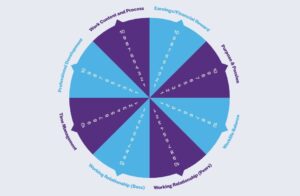
Considering each category in turn, decide how satisfied you feel with each. Where 0 represents ‘no satisfaction’ and 10 is ‘maximum satisfaction’ give a score for each of the eight categories. For example, if you’re very satisfied with your worklife balance right now, you might score that as a 9.
Place a mark on each line that records your score for that category. Working clockwise, draw a single line that passes through each of your mark.
2. Reflect and review
Ask yourself the following questions:
- How happy am I with the overall balance of my wheel?
- What areas of the wheel do I want to change and how?
- What might stop me shifting the balance of the wheel?
You might find it useful to draw another wheel for one of your past work roles and one for where you would like to be in your next role i.e. a visionary wheel that shows you what success looks like for you.
3. Plan for action
Consider the main differences between where you are currently and where you would like to be. These are likely to be the most important areas to focus on. Try to be specific about what would be different.
For each category you want to change, explore how you may achieve that. For example, could you achieve it in your current role, or is it more likely that you would have to change roles?
Write down three things that you want to start doing, stop doing or simply do more of that would positively affect that area of your life.
From all your actions, decide which two or three would make the biggest difference to your situation.
Share your exercise with someone you value and trust, gain their support for your development
A version of this article first appeared on our sister title Management in Practice.