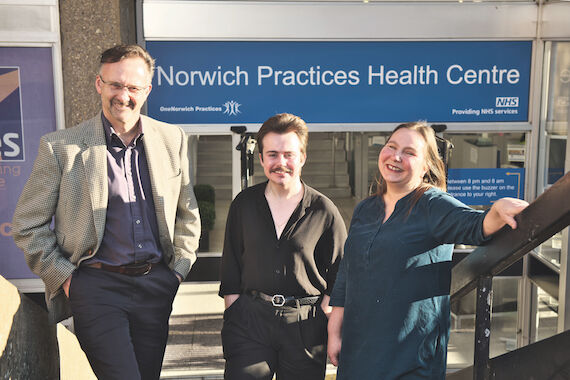
Norwich PCN triumphed as PCN of the year at the General Practice Awards 2022. Janka Rodziewicz, CEO of the PCN's delivery arm, outlines the work of this innovative network
OneNorwich Practices (ONP) is the delivery arm of the Norwich PCN and has gradually and consistently invested in its workforce. It now employs almost 200 staff. Each one is focused on supporting general practice and ensuring better outcomes for patients.
The secret of our success has been developing a culture of finding our own way within the parameters of the DES to bring stakeholders together and make things work not only for the benefit of the patients but also for the 22 GP practices and the local health system.
This approach has involved taking measured risks, doing things that have not been done before, talking to people and organisations we have not talked to before and rallying the support, commitment and belief of those around us to make things happen.
In the past two years, areas of focus include proactive recruitment to the additional roles reimbursement scheme (ARRS) and next year we will be working to a £5.2m budget. We have consistently used nearly the maximum available budget each year.
We have developed a range of services and roles to meet the ever-changing landscape of primary care. Through regular meetings with practice managers, commissioners and GPs it became clear that there were several problems common to almost all our practices:
- Difficulty recruiting new GPs.
- GPs retiring.
- An ageing population with more comorbidities.
- Growing health inequalities across the city.
- A high demand from our patients for face-to-face appointments.
- Difficulty retaining staff.
- A shortage of space in our practices to deliver services.
- A pent-up demand for services following Covid-19.
- Increased waiting times at the hospital.
- A lack of co-ordination between the different health services.
- Increased pressure on primary care.
- Increased pressure on acute care.
- Negative attention from the media.
ONP on behalf of the PCN took each of these issues and devised funding and effective solutions. Although we don’t claim to have cracked each issue, we are confident we have significantly improved the services our patients receive and reduced the burden on primary and acute care.
Broadly this work falls into three areas:
- Primary care transformation We support the PCN to develop sustainable and resilient practices by helping provide staff and expertise. We also bring together partners from GP practices, social care and the voluntary sector.
- Extended primary care We create collaborative at-scale services, to provide more care in the community and use research and data to design new opportunities for services in the community delivered collaboratively by practices and partners.
- Integrated population model of care We are designing a way to capture population health data to inform strategic commissioning and operational delivery. We are also developing integrated, extended multidisciplinary teams at practice and locality level to respond to planned and urgent care need, and promoting a shift in ethos from a reactive to proactive model of care.
Living Well team
Norwich has a diverse population. Many of these people present in general practice as they feel they have nowhere else to turn. The PCN, working in partnership with a voluntary care and social enterprise consortium, has created an effective social prescribing offer, which has supported large numbers of people.
The partnership was formed between the PCN and five providers - Equal Lives, Mancroft Advice Project (MAP), Shelter (Eastern region) Age UK (Norwich) and led by Norfolk Citizens Advice. This partnership not only uses local health intelligence to identify local needs but provides a full spectrum of support.
The social prescribing team is not only contributing to the PCN’s PC01 IIF indicator (number of referrals to social prescribing) it is also assisting with anticipatory and personalised care and helping practices achieve QOF targets.
Early estimates suggest the Living Well programme is delivering in excess of £5m in savings locally each year. This has provided a solid foundation on which the primary care community officer roles have been commissioned and developed.
As a result, the PCN has become confident in partnership working and has commissioned further services including a type 2 diabetes programme with Age UK Norwich, and a GP high intensity user programme with one of the local trusts. The Living Well programme has helped us create collaborative care for the patients who need it most.
Figures from the Living Well team project
- 22 practices actively referring (all practices in the PCN)
- 14.5 WTE staff
- Five provider organisations
- More than 1,000 people referred per year
- Improvements across all self-reported outcomes
- More than 1,000 shielding people supported during Covid
- £1.15m social return on investment per year
- £5m benefits in terms of better health based on quality-adjusted life years per year
Integrated motivational proactive anticipatory care team (IMPACT)
IMPACT is run by occupational therapist Lewis Roope, who, on behalf on the PCN, leads a team of five care co-ordinators hired via ARRS who support the anticipatory care agenda. The team contacts patients with COPD, asthma and type 2 diabetes to offer a personalised care review and a personalised care support plan. These plans look at all aspects of health and wellbeing including physical and mental health and also emotional and interpersonal relationships along with social issues of housing and employment. Then the team creates a shared action plan, which involves referrals across the PCN and to partner organisations.
We want to build on the good work that has already been done with the 22 GP practices in our PCN. We also hope to incorporate more local population data to anticipate patients’ needs more effectively.
Asthma in schools project
The issue was highlighted when a young patient failed to attend reviews and ended up in A&E. We recognised that the impact of an asthma programme could be significant and discussed this with potential partners. We also found that children from deprived areas were more than twice as likely to require emergency admission following an asthma incident, so we focused our resources in these areas.
Instead of the parent attending the GP practice for a review, the nurse attends the school. The parent is invited to the review in that familiar and convenient setting. The school also receives training on asthma. The project is run by paediatric children’s asthma nurse specialist Gina Eyles.
The programme targets children under 16 and invitations are sent to any patients on the asthma register. The school also notifies us of any known asthma patients. We also search the clinical systems to identify these children.
The 10 schools involved have been enthusiastic and accommodating. Where school nurses exist, they have also been supportive. We aim to work with 1,000 children.
While most children (52%) had their asthma under control we found 12% were very poorly controlled and 28% were only partially controlled. We also looked at inhaler technique and found 69% of children required correction. The National Review of Asthma Deaths (NRAD) recommended that all children should have a personal asthma action plan. Research suggests annual reviews and a personal asthma action plan halve the incidence of hospitalisation. Before our asthma in schools clinics, 81% did not have an asthma plan. Now, 100% of those reviewed have an asthma plan. Following positive feedback, the integrated care board (ICB) has provided financial investment to facilitate the expansion of the asthma in schools plan to the whole of Norfolk and Waveney.
The local East of England Health of the Nation 2022 heat maps inform us of the highest areas of deprivation and prevalence of childhood asthma and pinpoint the hotspots we need to prioritise, namely Lowestoft and Great Yarmouth, with the continued aim of reducing inequalities.
Figures from the IMPACT project
- The number of patients reporting problems with anxiety/ depression at three months decreased by 9.17%
- The incidence of problems reported with pain/discomfort decreased by 8.9%
- The percentage of patients reporting problems with self-care activities decreased by 8.88%
- The number of patients reporting problems with mobility decreased by 5.71%
- The incidence of problems reported with usual activities decreased by 3.96%
- Average HbA1c in the type 2 diabetes cohorts decreased by 14% to 83.3mmol/mol
- 93.57% of patients did not require additional GP care
- Hospital admissions decreased by 44.11%: £493,200 saved
- A&E attendances decreased by 23.43%: £52,055 saved
The General Practice Awards 2022 were run by Pulse PCN’s publisher Cogora. For more information and a list of the winners visit generalpracticeawards.com