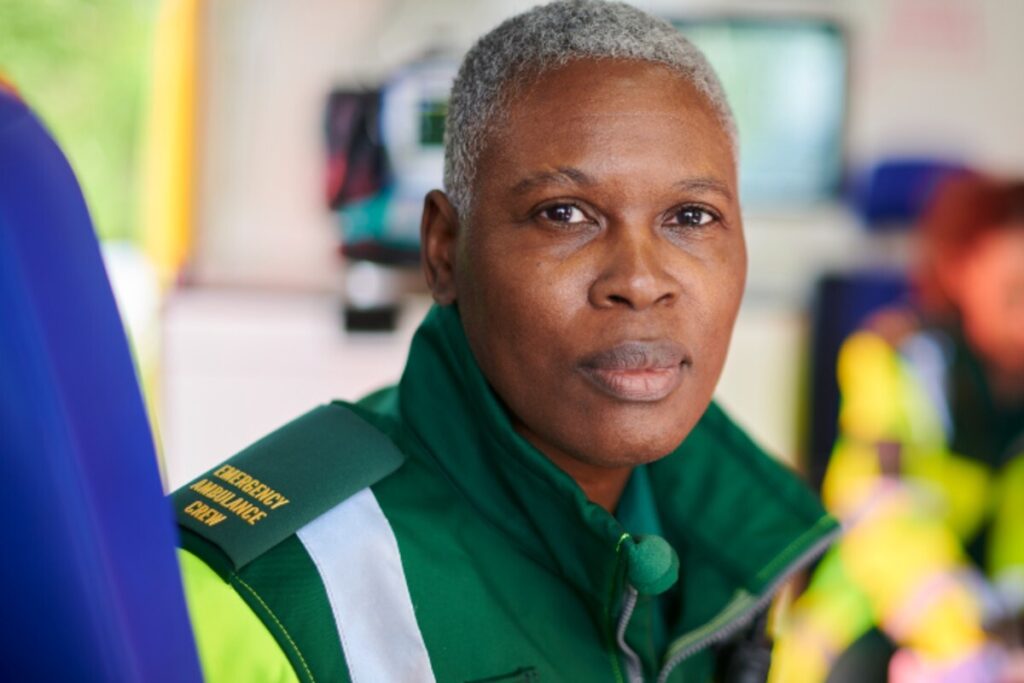

Paramedics employed under the additional roles reimbursement scheme (ARRS) can be a huge asset – but we must develop a more robust pathway into the sector, writes paramedic lead Jim Petter.
As a paramedic, I'm proud of our rapid evolution – from becoming a registrable profession in 2000 to independent prescribing as recently as 2018. That’s pretty dynamic professionalisation! ARRS turned a steady trickle of primary care recruits into a major stream in 2020.
Paramedics are well-regarded for their enthusiasm and ‘can-do’ approach; they care for patients across the age range and have an ability to connect quickly with them. There was always a natural affinity with primary care.
Way before ARRS, ambulance trusts were heavily engaged in reducing demand from the majority of 999 calls that were more akin to primary or urgent problems. A few started to upskill staff through postgraduate clinical education.
Not all ambulance trusts took the same approach, though, and to this day, there remains considerable regional variation around how paramedics manage low acuity cases safely and effectively (with a corresponding variation in trust rates of hospital non-conveyance).
Why is this background relevant to primary care? Because those paramedics who had been developed into primary and urgent care territory were already being equipped for practice work, often with great results.
ARRS arrived and catalysed small numbers into huge demand. Paramedics who had already been developed were at a major advantage and were already ahead of the game. If they hadn’t jumped ship into primary care already via direct practice funding, they were in demand through ARRS.
Understanding the complexity of primary care
Several lessons have been learned since ARRS went live. The scheme’s prerequisites of substantial post-registration experience plus postgraduate education are absolutely appropriate. But the focus on these elements, combined with a rush to recruit, often distracted employers from other equally important factors.
In a hurry to use the funding, employers and recruits could be naïve. Often, both sides were under-informed about what was being offered, what was required and what to look for. Written guidance from the centre, such as the ‘road maps’ only added to the confusion (as the King’s Fund pointed out) and increased the anxieties of both ARRS-funded recruits and existing practice-funded paramedics.
The initial rush to recruit may have slowed, but there is still much to learn. When practices ask what to look for, I suggest they find paramedics that really understand the complexity and intensity of primary care as very different from frontline 999 work.
For paramedics, primary care means long-term commitment into life as part of the wider practice team rather than managing care episodes with almost complete clinical autonomy. The change of mindset includes previously alien concepts such as watching and waiting, seeing the same patients again and again and taking a much more holistic approach.
Research bears out my own experience that two further factors are absolutely vital: socialisation within the team and clinical supervision (both formal and informal). To better understand paramedics as relative newcomers to primary care, there is some useful information available, such as the Oxford University toolkit.
Addressing salary inequities
While ARRS-funded recruitment is now less frenetic, paramedics with the right skills are still in demand. There remains much that could be done to oil the wheels of ARRS and make it less clunky
First, for paramedics to understand primary care and whether they want to work there, they need better exposure to it. To that end, pre-registration university elective placements which allow more insight are to be welcomed, unfortunately such placements are rare and becoming rarer.
Most paramedics don’t really understand what happens in the sector. Limited post-registration exposure means that making the move is often a huge act of faith or at worst, simply an adverse reaction to 999 work and ambulance service employment.
Opportunities for jobbing paramedics to truly observe primary care are scarce and arguably becoming more so. In my view, universities, PCNs and training hubs are well-placed to stimulate interest early on, by using pathways and tools such as apprenticeships, part-time contracts and, potentially, ARRS.
Which takes me to my next point. ARRS funding was set at the equivalent of (Agenda for Change) mid-Band 7. Most ambulance paramedics are Band 6. This created a salary that doesn’t sit well with a new recruit’s more realistic status as a trainee in primary care.
As a 2022 report from The King's Fund found, the rate of ARRS-funded pay also frustrated those more established, practice-funded colleagues who had made the move long before ARRS but were being paid the same. Paying newbies the same as old hands also creates unhelpful expectations to perform at the same level as their more established colleagues.
Looking to the future
Developing a more robust pathway into primary care would include more flexible application of ARRS funds, to enable pay which reflects status as either as trainees or as established (primary care) clinicians.
There is a higher-paid advanced practitioner (AP) ARRS-funded role which provides some greater range, but funded numbers are far smaller and the focus should be around creating more accessible pathways for those that are interested; a pipeline rather than a hurdle.
Ambulance services have become less anxious but still argue that ‘poaching’ paramedics into primary care is reckless. To me, this says more about relative job satisfaction. People are not widgets and the wider NHS benefits wherever paramedics work. And now that paramedics in possession of much greater skills are starting to return to ambulance services, they are realising the massive benefit.
As it stands, ARRS still feels more like a quick fix. It remains problematic and needs to evolve if it’s to have longevity and become the bedrock of a pathway into a truly multiprofessional sector.
Jim Petter is a Fellow of the Royal College of Paramedics and paramedic lead for BSW Training Hub